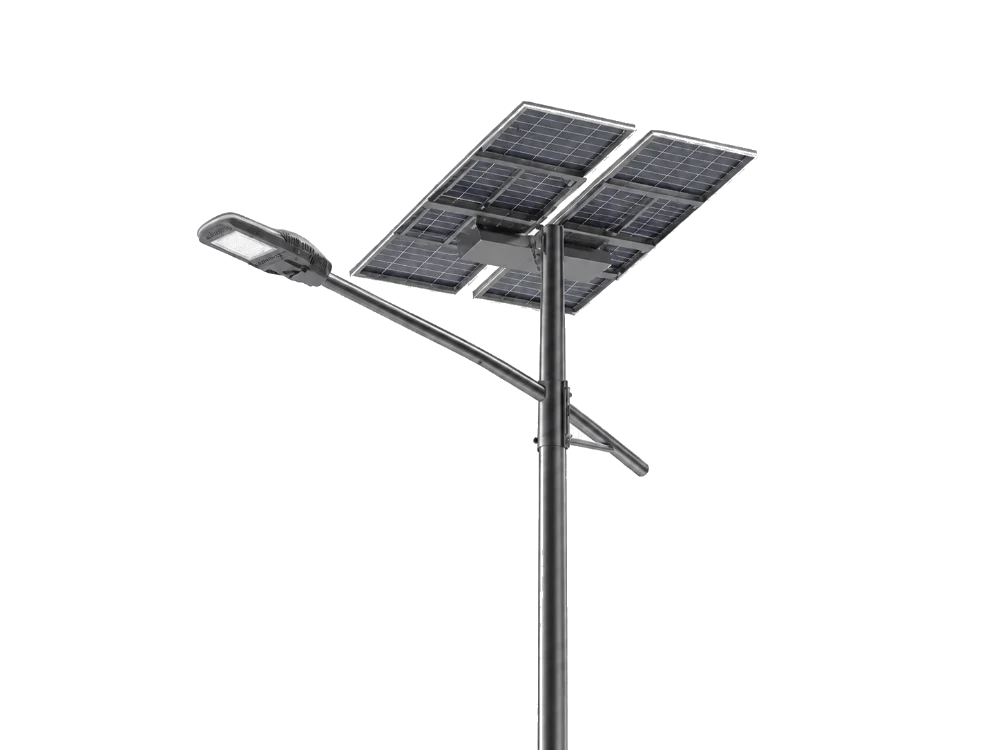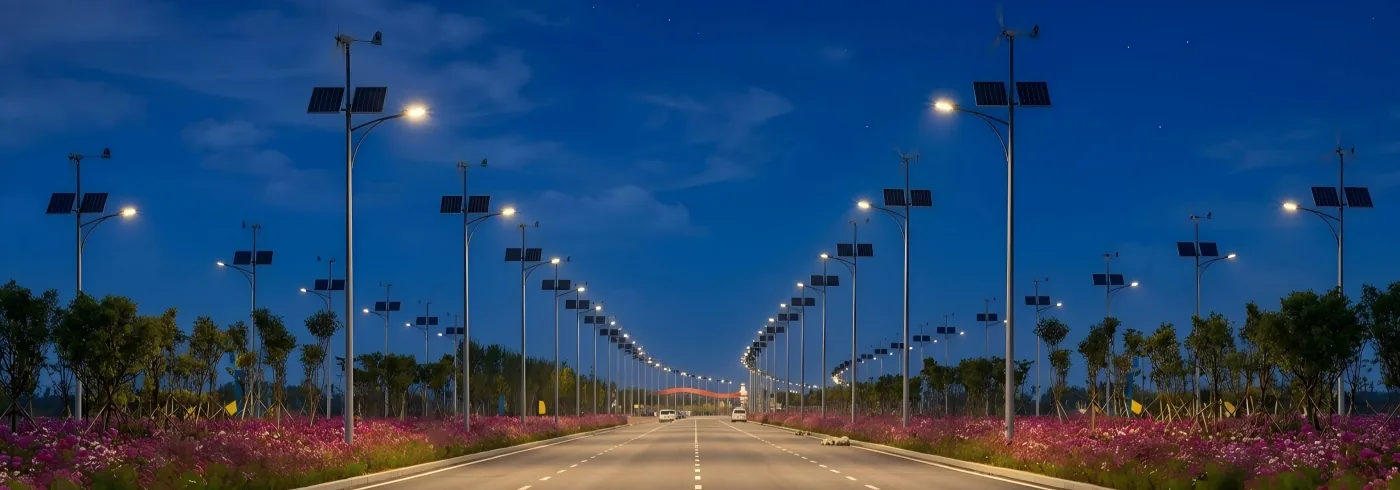
Wind Solar Hybrid Street Lights
Full wind & solar hybrid lighting range for 24/7 off-grid operation.
View Product
| Energy Source | Wind Turbine + Solar PV (Dual) | LED Range | 30W – 100W (4 Models) |
| Luminous Flux | 7,800 – 17,000 lm | Wind Turbine | 100W – 300W Horizontal Axis |
| Solar Panel | 70W – 240W Monocrystalline | Battery | Deep-Cycle Gel — Maintenance-Free |
| Controller | MPPT Hybrid — Wind + Solar Input | Pole | 6m – 11m Q235 Galvanized Steel |
| Arm Options | Single or Double Arm Config | Certifications | CE / RoHS / ISO9001 / ISO14001 |
Solar panels generate during daylight; the wind turbine produces power day and night, rain or shine. This dual-input architecture eliminates the single-point-of-failure risk of pure solar — critical for remote sites where a dark road is a safety hazard, not an inconvenience.
Because wind generates power overnight when solar cannot, the battery only needs to bridge occasional calm periods rather than every single night. This often allows 30-50% smaller battery sizing compared to an equivalent pure solar system — reducing both upfront cost and long-term battery replacement expense.
The very conditions that challenge pure solar — high winds, stormy weather, coastal fog, high-latitude winter darkness — are where wind turbines excel. Hybrid systems turn these environmental "problems" into energy advantages, making them the definitive choice for exposed coastal highways, tropical islands, and northern latitude installations.
While E-Able Power uses LiFePO4 in most solar-only products, our hybrid systems are specifically engineered with deep-cycle gel batteries for three reasons:
| Project Factor | Information Required | Why It Determines System Sizing |
|---|---|---|
| Wind & Solar Resource | Project GPS coordinates, local wind speed data, sunshine hours, shading, and seasonal weather patterns | Determines the wind turbine size, PV panel wattage, and energy mix ratio. Sites with 5+ m/s average wind speed benefit most from hybrid over pure solar. |
| Lighting Requirement | Road width, pole spacing, mounting height, target lux level, and nightly operating hours | Selects the LED wattage, optical lens distribution pattern (Type II/III), and pole arrangement. We provide DIALux simulation with lux maps. |
| Autonomy Target | Required backup days during calm/overcast periods, dimming schedule, control strategy | Sizes the gel battery capacity (Ah) and configures the MPPT hybrid controller's charge/discharge logic. |
| Structural & Environmental | Maximum wind gust speed, soil/foundation type, corrosion exposure (coastal/industrial), maintenance access | Defines the pole wall thickness, foundation dimensions, turbine mounting reinforcement, and anti-corrosion coating specification. |
Reference models for initial project discussion. Final configuration confirmed through site-specific wind/solar energy audit and structural engineering review.
| Model | LED / Lumens | Turbine / PV | Gel Battery | Pole | Suggested Use |
|---|---|---|---|---|---|
| BSW-6M30W | 30W / 7,800 lm | 100W / 70W | 12V 60Ah Gel | 6m Q235 | Rural paths, parks |
| BSW-8M50W | 50W / 8,500 lm | 200W / 120W | 12V 100Ah Gel | 8m Q235 | Community roads |
| BSW-10M80W | 80W / 13,600 lm | 300W / 190W | 12V 180Ah Gel | 10m Q235 | Coastal highways |
| BSW-11M100W | 100W / 17,000 lm | 300W / 240W | 12V 110Ah × 2 Gel | 11m Q235 | Remote highways, industrial |
A hybrid system becomes advantageous when the annual average wind speed exceeds 4-5 m/s at hub height. Our engineering team assesses this using global wind resource databases (Global Wind Atlas, NASA MERRA-2) based on your project GPS coordinates. Coastal sites, hilltops, open plains, and mountain passes almost always qualify. If your site averages below 3 m/s, a pure solar system is typically more cost-effective — and we will recommend accordingly rather than overselling the hybrid approach.
Gel batteries are specified for hybrid systems for three engineering reasons: (1) They operate reliably at -40°C where LiFePO4 performance degrades significantly — critical for high-altitude and high-latitude sites. (2) Their deep-cycle tolerance handles the irregular charge pattern of wind energy (gusty, intermittent) better than many lithium chemistries. (3) Zero-maintenance sealed construction is ideal for remote sites where annual servicing is the only access window. For customers who specifically prefer lithium, LiFePO4 configurations are available for bulk OEM orders.
The system is designed for minimal annual maintenance. The wind turbine uses sealed bearings rated for 5+ years; the solar panel is self-cleaning at typical tilt angles; the gel battery requires no water topping or equalization. Recommended annual inspection includes: visual check of turbine blade integrity, bolt torque verification on the turbine mount and pole flange, panel surface cleaning if heavily soiled, and battery voltage test. For large deployments, we provide a maintenance schedule checklist and can arrange local service partner training.
Yes — both single-arm and double-arm configurations are available across all BSW models. Single-arm is standard for one-sided road lighting. Double-arm is ideal for dual-carriageway medians, wide boulevards, and central pathways where one pole illuminates both sides. The hybrid power system (turbine + panel + battery) is sized identically; only the luminaire count and pole bracket design change. Specify your preference when requesting a quotation.
All E-Able Power products undergo 100% QC inspection. Factory: Dongguan, Guangdong, China.
Send your site conditions, lighting requirements or load profile for a system engineered to your location — DIALux simulation, sizing and pricing within 2–3 business days.