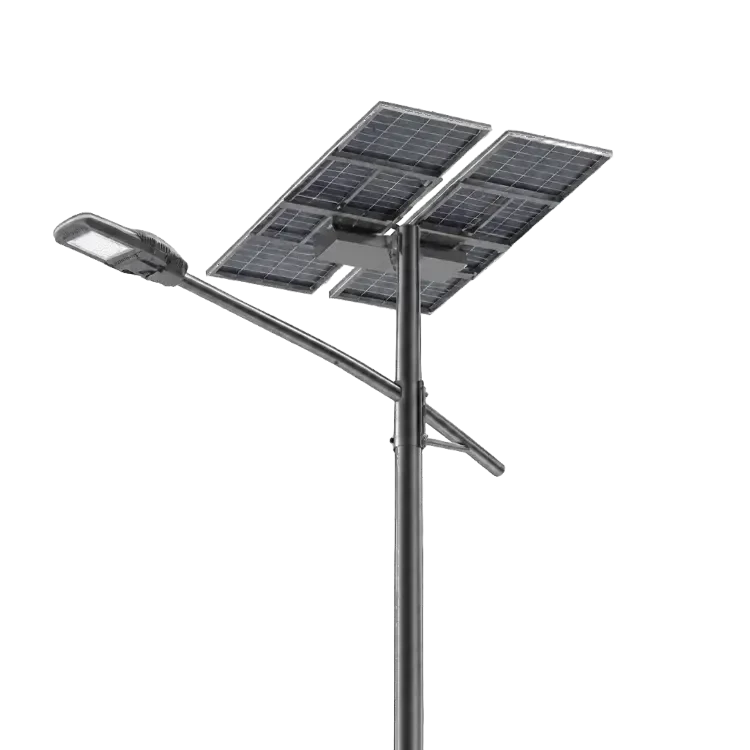
Split solar street light
50W Split Solar Street Light - 7M Single Arm
50W Lumileds 3030 LEDs at 170LM/W with a 100W mono solar panel and durable LiFePO4 battery, on a 7-meter single-arm pole for highways, gardens and municipal roads.
VIEW PRODUCT →
Print-ready PDF — specifications and installation in one place, no login required.
Panel, battery and fixture are separated so each can be sized and aimed on its own — independent PV orientation, scalable LiFePO4 capacity and easier maintenance. 50W to 100W single-arm and double-arm builds on 7–10m poles for roads, highways and municipal projects. For the sizing inputs behind this range, see the solar street light buyer's guide.
Split solar street light
50W Lumileds 3030 LEDs at 170LM/W with a 100W mono solar panel and durable LiFePO4 battery, on a 7-meter single-arm pole for highways, gardens and municipal roads.
VIEW PRODUCT →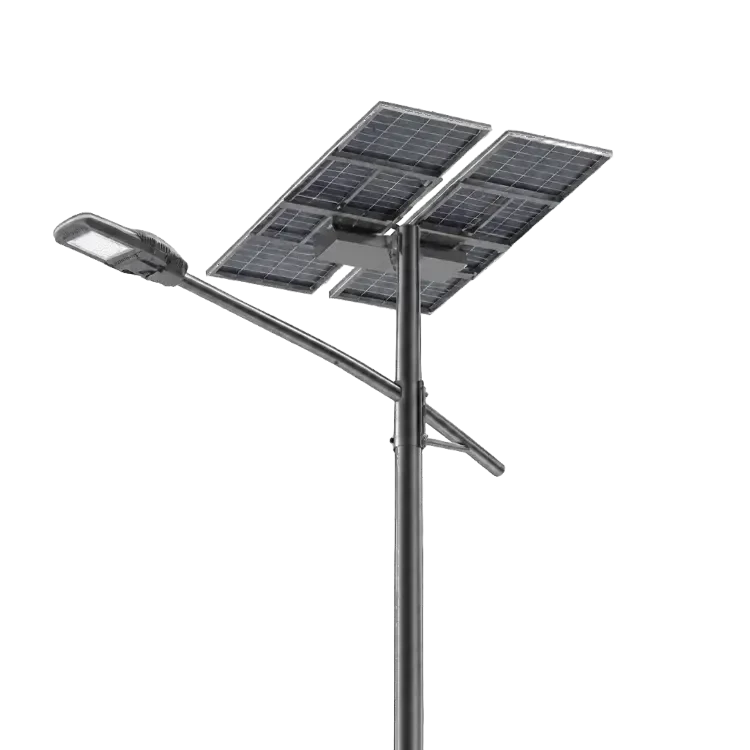
Split solar street light
60W LED engine at 170LM/W with a 120W monocrystalline panel, 12.8V 60Ah LiFePO4 battery and 10A MPPT controller on an 8-meter Q235 galvanized pole.
VIEW PRODUCT →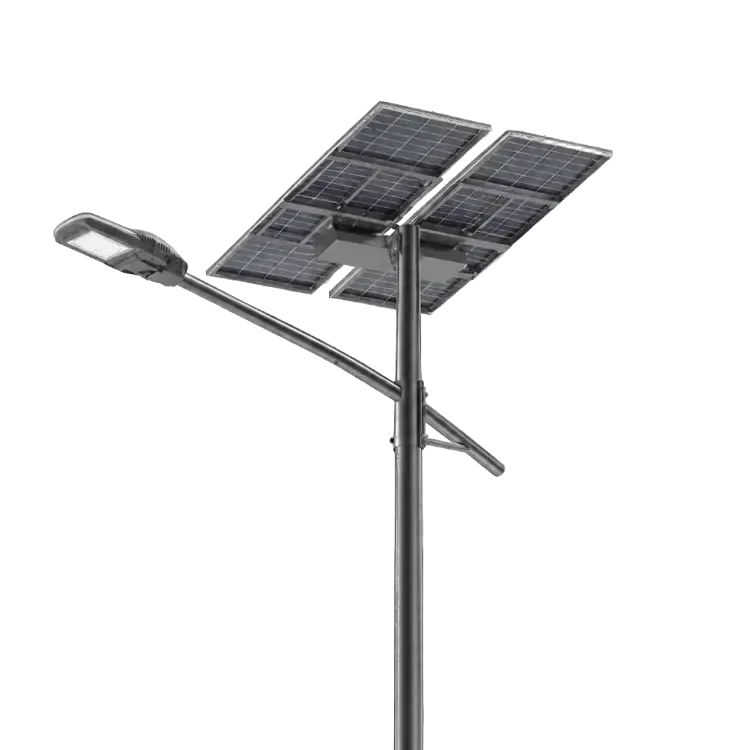
Split solar street light
80W high-efficacy luminaire with independent panel orientation, IP65/IP68 enclosures and 3-4 nights overcast autonomy on a 9-meter single-arm galvanized pole.
VIEW PRODUCT →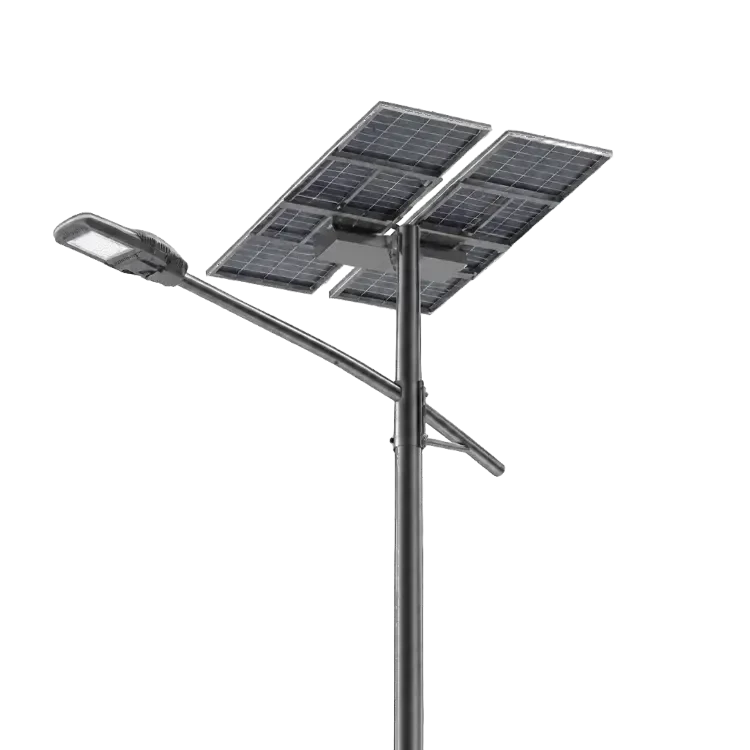
Split solar street light
200W monocrystalline panel, 100W LED luminaire and 307.2Wh+ LiFePO4 bank with IP68 MPPT controller for 10-12 hours of nightly operation on a 10-meter pole.
VIEW PRODUCT →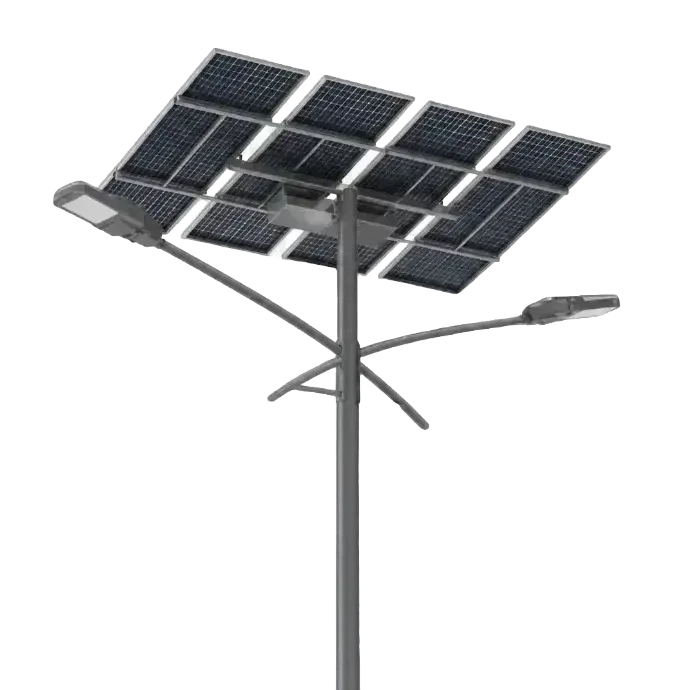
Split solar street light
Dual 50W LED luminaires on a single 7-meter pole illuminate both carriageways from one foundation, with dual mono panels, twin LiFePO4 packs and 10A MPPT controllers.
VIEW PRODUCT →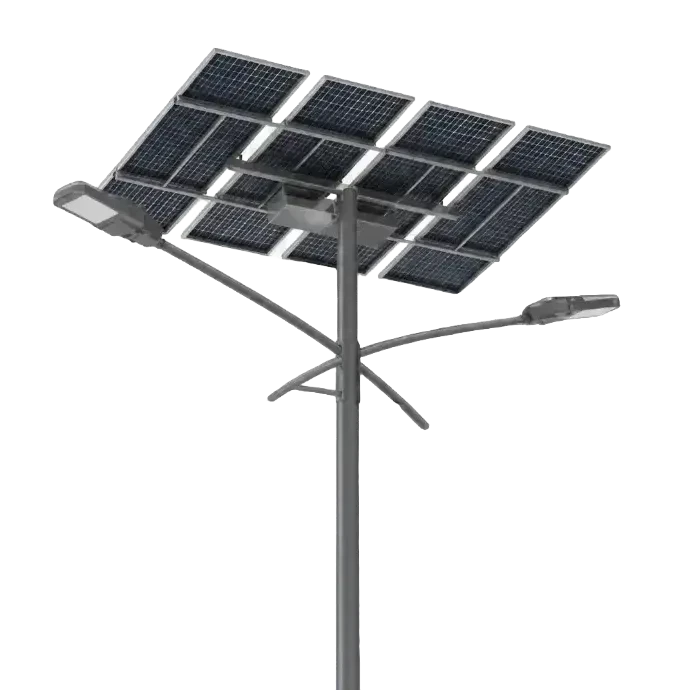
Split solar street light
Heavy-duty 8M double-arm split light with 60W LED, 120W mono panel and 60Ah LiFePO4 battery at 170LM/W, with DIALux analysis and load calculations available.
VIEW PRODUCT →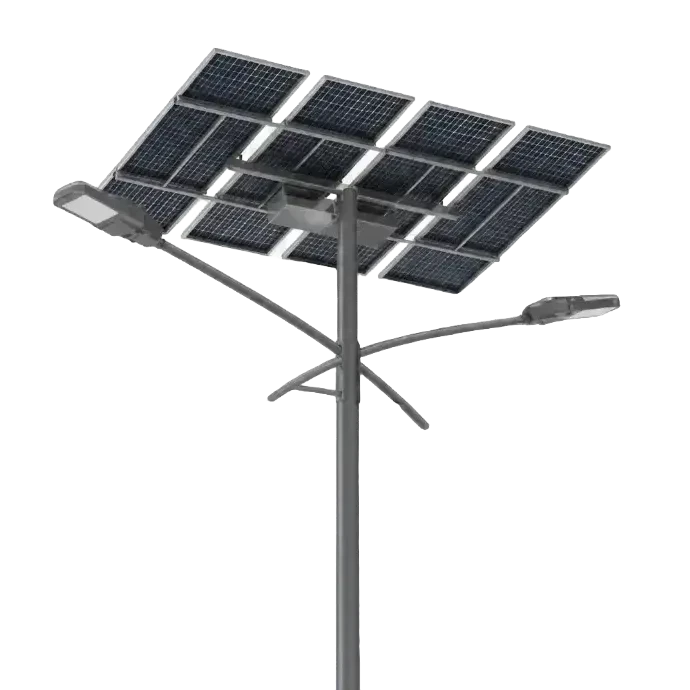
Split solar street light
Dual 80W LED luminaires with Lumileds 3030 chips, twin 150W panels and dual 12.8V 80Ah LiFePO4 packs on a 9-meter galvanized pole for arterial roads.
VIEW PRODUCT →A split system is specified when the road, not the fixture, sets the size.
Separating the panel, the battery and the luminaire lets each part be sized for the road instead of for one enclosure. That is why split systems dominate municipal and arterial work: lit width, pole height and autonomy can be raised together without redesigning the fixture.
Single-arm builds from 50W to 100W on 7–10 m poles cover two-lane municipal roads, rural access roads, estate and campus roads, industrial park perimeters and car park aisles. Double-arm builds from 50W to 80W on 7–9 m poles light both carriageways of a divided road from one foundation, which removes a row of poles and one line of trenching.
The same layout suits a site whose pole line is already fixed, where a split solar head replaces a grid lantern and reuses the existing pole, provided the pole and foundation are checked for the added panel and arm load.
A split pole carries a panel, an arm and two cable runs, so the civil work decides how long the system lasts.
The structure is a Q235 galvanised pole — 7–10 m on single-arm builds, 7–9 m on double-arm — with the panel on its own bracket above the arm. Foundation design follows the local wind load and soil conditions; we issue the anchor-bolt template and the load calculation so the foundation is cast once, correctly.
Two cable runs leave the pole: panel to controller and battery, and battery to luminaire. Route both inside the pole where the design allows, leave a drip loop at every gland and seal the entries. Water in a gland is the most common field failure on a split system — it takes months to show and is usually blamed on the battery.
Aim the panel at the equator at the site latitude — due south in the northern hemisphere, due north in the southern — and check the winter sun path before the bracket is fixed. A panel shaded at 09:00 in December is a smaller system than its nameplate says.
Commissioning is one check: after the first clear day the battery should reach full charge. If it does not, the panel is undersized for that site or the dimming profile is heavier than the design assumed.
Autonomy is a sizing decision made in the offer, not a property of the battery.
Standard builds use 12.8 V LiFePO4 packs — 60 Ah and 80 Ah are the common sizes in this range, with two packs on the double-arm models. LiFePO4 is specified for cycle life and for a discharge curve that keeps the driver voltage stable as the pack empties.
Standard configurations are engineered for 3–4 nights of overcast running at the programmed dimming profile. Longer backup comes from a larger pack; adding panel alone will not carry a site through a week of cloud.
Four inputs move the number: nightly operating hours and dimming steps, winter sun hours at the latitude, battery temperature — capacity falls in cold, and a cabinet in direct sun runs hotter than the ambient figure — and the depth of discharge the BMS allows. Send us the first three and we will size the fourth.
MPPT charging is standard: 10 A controllers on the smaller builds and an IP68 controller on the 100W single-arm, so the pack recovers from partial sun and not only from a clear day.
170 lm/W describes the LED, not the road.
Every model in this range uses Lumileds 3030 chips at up to 170 lm/W, so the headline lumens are the LED output at a given drive current. Two fixtures quoting the same wattage can differ once lens loss, driver efficiency and the selected colour temperature are counted.
Compare fixture lumens at the same colour temperature, then compare what reaches the surface. Pole height, arm length, tilt and spacing decide illuminance and uniformity far more than the chip does, which is why we run the DIALux model on the actual layout instead of quoting a wattage per kilometre.
A split system is inspected as a whole, so the paperwork has to cover more than the lamp.
The fixture is supplied with CE marking supported by EMC and LVD test reports, and IEC-referenced test data where a specification cites IEC standards. Manufacturing is under ISO 9001, ISO 14001 and ISO 45001.
A split system adds two things a tender will ask about: the battery cabinet and the cable between panel and cabinet. Ask whether the certificate set covers the exact model and cabinet being supplied, and whether the DC cabling is included in the scope, because on site the inspection treats them as one installation.
Where a project requires grid-code or fire-safety documentation, tell us the standard before the offer — confirming afterwards usually costs a week.
A split solar street light separates the solar panel, battery and LED luminaire into independent components on the pole. Unlike an integrated all-in-one unit, each part can be sized and aimed on its own — so the PV panel is oriented for maximum sun, the LiFePO4 battery is scaled to the site's autonomy needs, and the lamp is positioned exactly over the road for better light distribution.
A single-arm split solar street light fits one LED header laterally over the carriageway, ideal for two-lane roads, pathways and side streets. A double-arm split solar street light mounts two opposing LED heads on the same pole, illuminating both carriageways of a wider road from a single foundation and pole — reducing total poles, trenching and cost on arterial and multi-lane roads.
E-Able Power split solar street lights are available from 50W to 100W LED output, with single-arm builds on 7–10 m poles and double-arm builds on 7–9 m poles. Each system pairs a monocrystalline PV panel (100W–200W) with a LiFePO4 battery bank and MPPT charge controller matched to the site's operating hours and solar resource.
Depending on the battery capacity and LED load, split systems are typically engineered for 3–4 nights of overcast / rainy-day autonomy, with higher-capacity LiFePO4 packs available for longer backup. E-Able Power sizes the panel and battery to your project's required backup and geographic region.
A split design offers independent panel orientation, larger and easier-to-service LiFePO4 capacity, and lower wind load on the pole. It is the preferred choice for municipal roads, highways, industrial parks and remote sites where higher light output, longer autonomy or better solar access matter more than the compactness of an all-in-one fixture.
Yes. E-Able Power engineers each system factory-direct for distributors, contractors and project owners — configuring LED wattage, pole height, panel size, battery autonomy, arm configuration and OEM/ODM branding, with DIALux simulation, wind-load and foundation calculations, tinting and pricing support.
Discuss product selection, project conditions and OEM/ODM requirements with the E-Able Power team for a system engineered to your site.
Choosing between configurations? Read the solar street light buyer's guide for the four decisions in order.